

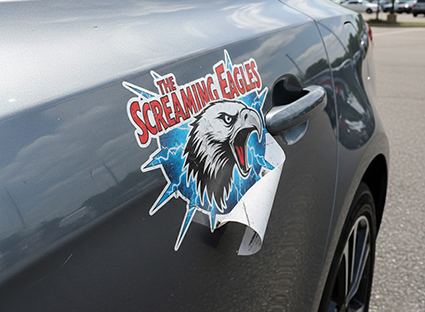
Vinyl lifting or peeling is one of the most common issues faced during or after installation, whether the application is vehicle graphics, window film, wall décor, or signage, lifting edges can affect appearance, durability, and customer satisfaction.
Understanding why vinyl lifts or peels, and knowing how to fix and prevent it, will help installers, dealers, and end users achieve long-lasting, professional results.
Common Reasons Why Vinyl Lifts or Peels
1. Poor Surface Preparation
This is the number one cause of vinyl failure.
Problems include:
- Dust, grease, wax, silicone, or oil on the surface
- Cleaning with household cleaners that leave residue
- Moisture trapped under the film
Vinyl adhesive needs direct contact with a clean surface to bond properly.
2. Incorrect Surface Type
Not all surfaces are vinyl-friendly.
Vinyl may lift on:
- Low-surface-energy plastics (PP, PE, textured plastics)
- Rough or porous surfaces
- Old paint or flaking coatings
If the surface energy is too low or uneven, the adhesive cannot anchor properly.
3. Application Temperature Issues
Vinyl adhesives are temperature-sensitive.
Typical problems:
- Installing in cold environments (below recommended temperature)
- Applying vinyl to surfaces that are too hot
- Large temperature changes after installation
Adhesive needs the correct temperature range to flow and bond effectively.
4. Insufficient Pressure During Installation
Vinyl is pressure-activated, if pressure is uneven or too light:
- Adhesive does not fully engage
- Edges and curves lift first
- Air channels may remain open
Simply placing vinyl is not enough, proper squeegee pressure is critical.
5. Complex Shapes, Curves, and Edges
Edges and curves are stress points.
Common mistakes:
- Stretching vinyl too much
- Not post-heating after installation
- Wrapping vinyl too tightly around sharp edges
Vinyl has memory, without proper technique, it will try to return to its original shape.
6. Incorrect Vinyl Selection
Using the wrong type of vinyl for the application can cause failure.
Examples:
- Indoor vinyl used outdoors
- Removable adhesive used for long-term applications
- Calendered monomeric vinyl used on deep curves
Always match the vinyl type to the application environment and surface.
How to Fix Lifting or Peeling Vinyl
a. Fixing Minor Edge Lifting
For small lifting areas:
- Clean the surface again (use isopropyl alcohol)
- Gently lift the vinyl edge
- Reapply with firm pressure
- Use gentle heat to activate adhesive
- Press down and allow cooling
b. Re-activating Adhesive with Heat
Heat helps adhesive flow and bond.
Tips:
- Use a heat gun or heat source carefully
- Do not overheat (can damage vinyl)
- Apply pressure while the vinyl is warm
- Let it cool naturally before releasing pressure
c. Using Edge Sealing Techniques
For outdoor or high-stress applications:
- Apply edge sealers where needed
- Avoid trimming vinyl exactly at edges — leave a small margin
- Round corners instead of sharp cuts
d. When to Replace the Vinyl
If lifting continues:
- Adhesive contamination may be permanent
- Surface may be incompatible
- Vinyl may be overstretched or damaged
Under these circumstances, removal and reinstallation is the best solution.
Conclusion
Vinyl lifting or peeling is rarely caused by the material alone, in most cases, it is the result of surface preparation, application technique, environmental conditions, or incorrect product selection.
By understanding these factors and following best practices, installers and end users can achieve clean edges, strong adhesion, and long-lasting results, maximizing both performance and customer satisfaction.